


Hundreds of farmers from across the country yesterday staged a rally in Taipei to protest against the government’s “arbitrary regulations” that deprive them of their right of abode and their livelihood.
The parade started from the Council of Agriculture’s Forestry Bureau and ended at Ketagalan Boulevard in front of the Presidential Office.
Holding banners that read: “Give us back our land,” the protesters, many of whom were elderly farmers, appealed to the government to allow them to continue growing fruit and crops on the land that they have cultivated for years, instead of restraining their right of abode by designating these areas as national parks.

Photo: George Tsorng, Taipei Times
Tseng Te-tsung (曾得總), general-director of the parade and chairperson of Taiwan Original Cultivation Farmers’ Association, said many of the farmers and their families had been farming their lands since the Japanese colonial era (from 1895 to 1945) or long before that.
However, when the Chinese Nationalist Party (KMT) government took over from the Japanese colonial government, it arbitrarily designated large tracts of the land as national parks and placed them under state ownership, Tseng said.
A fruit farmer surnamed Chen (陳) from Greater Kaohsiung’s Tianliao District (田寮) said: “We farmers don’t ask for a wealthy life, but when the government takes our land, it not only deprives us of our possessions, but also puts us out of work.”
Chen accused the government of violating the Constitution, which guarantees protection of people’s right of habitation and livelihood.
He added that the government should assist self-farming land owners and people who live on the land when planning and redistributing land resources.
Many farmers don’t understand the law that protects their rights and many were not given the chance to apply and register for ownership over the land, he said.
Many farmers are only allowed to temporarily rent the farmlands that they have been living on for decades, he said.
A fruit farmer surnamed Tsai (蔡), having been forced to tear down many parts of his house already, said he was recently fined another NT$120,000 for occupying state-owned property.
He said the government has been bullying farmers for many years, but all they ask for is the legitimacy to continue farming and living on the land.
The farmers urged the government to rethink its land redistribution policy instead of arbitrarily driving out those who have lived on the land for years or accusing them of breaking the law.
Taiwan Solidarity Union Chairman Huang Kun-huei (黃昆輝), who took part in the protest, said the government was wrong to dispossess farmers of the land and prosecute them for occupying state land.
“If these cases continue to happen, it will only generate hatred among the people,” he said.
In a statement released last night, the Forestry Bureau said: “The management of national parks and related measures will be modified in consideration of the farmers.”
“Standard acts of changing national parks into private land will be discussed with other related government agencies,” it added.

AGING: While Japan has 22 submarines, Taiwan only operates four, two of which were commissioned by the US in 1945 and 1946, and transferred to Taiwan in 1973 Taiwan would need at least 12 submarines to reach modern fleet capabilities, CSBC Corp, Taiwan chairman Chen Cheng-hung (陳政宏) said in an interview broadcast on Friday, citing a US assessment. CSBC is testing the nation’s first indigenous defense submarine, the Hai Kun (海鯤, Narwhal), which is scheduled to be delivered to the navy next month or in July. The Hai Kun has completed torpedo-firing tests and is scheduled to undergo overnight sea trials, Chen said on an SET TV military affairs program. Taiwan would require at least 12 submarines to establish a modern submarine force after assessing the nation’s operational environment and defense

A white king snake that frightened passengers and caused a stir on a Taipei MRT train on Friday evening has been claimed by its owner, who would be fined, Taipei Rapid Transit Corp (TRTC) said yesterday. A person on Threads posted that he thought he was lucky to find an empty row of seats on Friday after boarding a train on the Bannan (Blue) Line, only to spot a white snake with black stripes after sitting down. Startled, he jumped up, he wrote, describing the encounter as “terrifying.” “Taipei’s rat control plan: Release snakes on the metro,” one person wrote in reply, referring
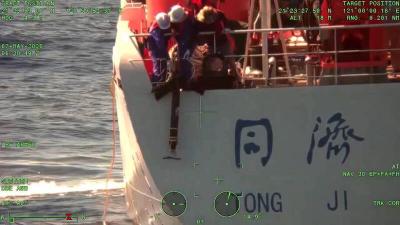
The coast guard today said that it had disrupted "illegal" operations by a Chinese research ship in waters close to the nation and driven it away, part of what Taipei sees a provocative pattern of China's stepped up maritime activities. The coast guard said that it on Thursday last week detected the Chinese ship Tongji (同濟號), which was commissioned only last year, 29 nautical miles (54km) southeast of the southern tip of Taiwan, although just outside restricted waters. The ship was observed lowering ropes into the water, suspected to be the deployment of scientific instruments for "illegal" survey operations, and the coast

Taiwan’s two cases of hantavirus so far this year are on par with previous years’ case numbers, and the government is coordinating rat extermination work, so there should not be any outbreaks, Centers for Disease Control (CDC) Director-General Philip Lo (羅一鈞) said today in an interview with the Liberty Times (the Taipei Times’ sister newspaper). An increase in rat sightings in Taipei and New Taipei City has raised concerns about the spread of hantavirus, as rats can carry the disease. In January, a man in his 70s who lived in Taipei’s Daan District (大安) tested positive posthumously for hantavirus, Taiwan’s


 RSS
RSS